Skip to content

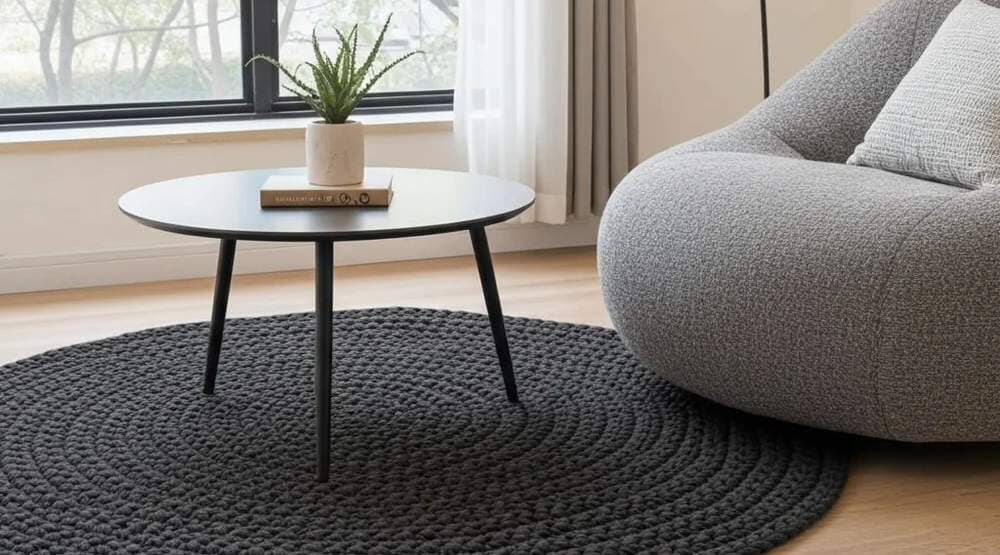
A handmade cotton crochet mat needs care that suits both its yarn and its construction. Cotton fibre alone does not tell you whether a finished piece belongs in a washing machine or tumble dryer. Size and weight matter too.
This guide focuses on the unbacked, handmade mats in our range made from 100% cotton t-shirt yarn, sometimes called tarn. These mats do not have sewn-in care labels. Their care guidance allows machine washing and cool tumble drying, or a gentle cold-water soak followed by flat drying in the sun. This guidance should not be applied automatically to other crochet mats, especially pieces with a backing, mixed fibres or added decoration.
Before you wash: check the mat and the machine

Look over the edges and stitches before the mat gets wet. Check for pulled loops, loose ends or areas that are coming apart. Photographing the mat laid flat gives you a useful reference for its shape afterwards.
The larger mats are very heavy and may not suit a smaller washing machine. If a mat feels too heavy or too large for your machine, it probably is. Do not force it into the drum: being machine washable does not mean that every size fits every machine.
A larger-capacity top loader may work, but it is not an automatic solution. The mat still needs room to move, and the load must be within the machine manufacturer's guidance for bulky items. If either the weight or the fit seems wrong, choose the cold-soak method instead.
Washing: machine wash or a gentle cold soak?
For these cotton crochet round mats and bathmats, both machine washing and a gentle cold-water soak are care options. Use machine washing only when the mat's size and weight suit the appliance. Do not assume that a hot cotton cycle used for towels is suitable for a handmade crochet mat.
A gentle soak in cold water is the alternative when the mat is too bulky for the machine. Plan where you will wash and dry it before starting, particularly with a larger mat that will be awkward to move when wet.
Handle the wet mat gently and support the whole piece when lifting, rather than taking its weight by one corner. Avoid forceful twisting or wringing. The care guidance for this range does not prescribe a particular detergent, soaking time or spin setting, so this guide does not invent one.
Reshaping without stretching
Lay the mat flat to dry, using its original outline as your reference. A round mat should sit in a circle, while a rectangular mat should have its edges gently aligned.
Ease it into position with your hands rather than pulling hard on an edge or an individual stitch. Reshaping is not an attempt to stretch it to a new size. Small variations in dimensions are part of the handmade character of this range; aim for a natural, even outline rather than forcing every edge into perfect symmetry.
Drying thoroughly matters as much as washing

The care guidance recommends flat drying in the sun for faster drying. Choose a clean, suitable drying surface with good airflow. Keep the mat spread out rather than folded or rolled, and check the underside and thicker areas before returning it to the floor. A surface that feels dry does not necessarily mean the whole mat is ready.
There is no single drying time to promise. Mat size, thickness, weather and the drying space all affect the process. Allow it to dry completely before placing furniture on it, rolling it up or storing it away.
Cool tumble drying is also an option for this range, but only if the mat fits comfortably within your dryer's capacity guidance. Do not use high heat or squeeze a large, heavy mat into a small dryer. Flat drying is the alternative when the appliance is not a suitable fit.
What to do about a pulled loop
A loop sticking up is not an invitation to reach for scissors. Leave it uncut and avoid tugging it or trying to hide it with glue. Resist pulling neighbouring stitches to force the loop back into place.
A stretched stitch, a loose yarn end and a broken strand are not the same problem. There is no maker-confirmed repair technique included in this range's care guidance, so a universal crochet-hook fix would be misleading. The practical precaution is to avoid making the snag worse: leave it alone rather than cutting, pulling or improvising a repair. If stitches are opening up or the yarn is broken, pause washing rather than treating the mat as undamaged.
The simple rule: washable does not mean it fits every machine
For these cotton t-shirt-yarn mats, the care options are machine washing, cool tumble drying, or a gentle cold soak followed by flat drying in the sun. Choose the method that suits the size and weight of your mat. If it feels too big or too heavy for the washing machine, it probably is. Handle the stitches gently, reshape without stretching, and let the whole mat dry before putting it back into everyday use.